Mövenpick Resort & Spa Dead Sea — Pool Heating Engineered for Exceptional Site Conditions
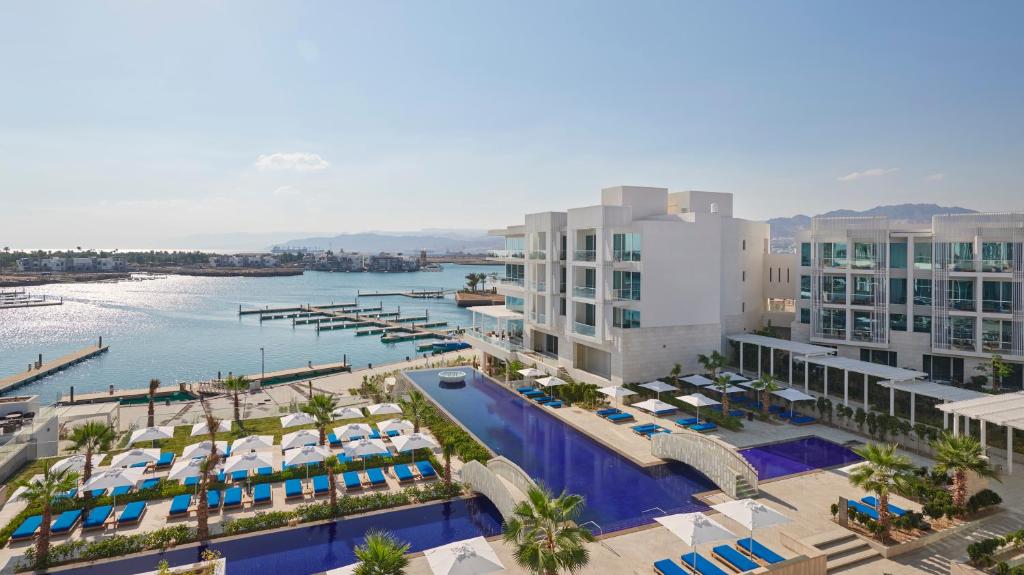
At Mövenpick Resort & Spa Dead Sea, pool heating is not simply a matter of reaching a target water temperature. The project had to account for the site’s unique climatic and chemical conditions. During hot periods the pool is exposed to significant solar gains, while in cooler periods water temperature drops after sunset, requiring a system capable of maintaining stable conditions and guest comfort.
The Dead Sea location provides unusual operating conditions for air-source heat pumps. The resort is situated more than 400 meters below sea level, where atmospheric pressure and air density are higher than at typical elevations, while winter ambient temperatures are relatively mild. These site conditions were considered as part of the system design and operation.
The more critical challenge, however, was on the water and materials side. The local environment contains salt and bromide, while pool water itself is chemically aggressive to mechanical equipment. Pool water was therefore prevented from circulating directly through the heat pumps. Instead, the pool circuit was isolated through shell-and-tube heat exchangers, with the filtration and circulation loop rebuilt around them.
This approach separates the heat pump equipment from the pool water chemically, turning a system that simply works on day one into one designed to remain reliable over the long term.
The work was completed within an operating resort without shutting down the facility, while the existing system was retained as backup to maintain the level of redundancy expected in a five-star hospitality environment. Consumption and performance data are still being collected, so no savings figure is published until a reliable measurement period is complete.
Challenges
Providing stable pool heating at an operating resort under the unique conditions of the Dead Sea, while managing seasonal thermal loads and the corrosive effects of salinity, bromide, and aggressive pool-water chemistry on mechanical equipment.
The project also had to be implemented without interrupting resort or pool operation, while maintaining a backup system for service continuity.
Solutions
MICROWELL heat pumps were selected for pool heating, with the system engineered around the actual climatic conditions of the Dead Sea location.
On the water side, the pool circuit was completely isolated from the heat pump equipment through shell-and-tube heat exchangers. The filtration and circulation loop was reconfigured so that chemically aggressive pool water never passes directly through the heat pumps.
This separation protects the mechanical equipment from salinity and chemical exposure, supporting long-term reliability, while the existing system was retained as operational backup to preserve redundancy and service continuity.